
CU Boulder’s Center for National Security Initiatives
Data Exploitation Lab for Trusted Autonomy
Overview
Copeland is employed as a graduate computer science researcher at the Center for National Security Initiatives (NSI) specifically working out of the Data Exploitation Lab for Trusted Autonomy (DELTA) under the supervision of Dr. Greg Furlich. Copeland works primarily on the OWLAT (Open Data Weather Imagery Launch Alerts and Tracklets) research project which is integrated into the SDA TAP accelerator Lab infrastructure and is funded by the Aerospace Corporation.
AEE Abstract Submission for Speaker Presentation
The United States Space Force and Intelligence Community maintain highly capable early missile warning systems; however, access to these systems and their alerts is inherently restricted, limiting their availability for unclassified research, development, and analysis. Prior work demonstrated that meteorological geostationary satellites, such as the NOAA Geostationary Operational Environmental Satellites (GOES), can be leveraged to observe space launch events and provide unrestricted launch alerts to the Space Domain Awareness (SDA) Tools, Applications, and Processing (TAP) Lab at Colorado Springs. Our research extends this capability by expanding launch detection beyond U.S. geostationary weather satellites to include international weather satellites, specifically Japan’s Himawari and South Korea’s GEO-KOMPSAT-2A (GK2A).
We then construct a large, multi-sensor, multispectral dataset of confirmed launch observations using GOES, Himawari, and GK2A imagery, enabling comparative statistical analysis across these platforms. Using this launch dataset, we evaluate the relative effectiveness of multiple spectral bands for launch detection and tracking. These statistical findings further inform the development of a convolutional neural network (CNN) to improve automated launch detection accuracy, robustness, and reduction of the false detection rate compared to a traditional threshold-based method used in previous iterations of this project. Currently, our CNN sits at 97.3% accuracy for detecting launches occurring within 3 minuted of takeoff, compared to 67.0% for thresholding. Together, these advancements demonstrate the utility of a scalable, unclassified launch detection capability for the USSF SSC SDA TAP Lab and further operational environments. Our work provides support for future unclassified research and development in both launch detection and tracking, as well as downstream, mission-critical space domain awareness operations.
Copeland’s Research Focus / Contributions
Copeland is currently a primary researcher on the OWLAT project where he expanding the project’s functionality and operational capacity. Firstly, he has been extending OWLAT’s capabilities beyond national resources to include international geostationary weather satellites, primarily Himawari (Japan) and GK2A (South Korea). Through his development of novel computer vision detection algorithms Copeland has been able to use Himawari and GK2A to detect and track numerous rocket launches originating from Japan, South Korea, North Korea, and China.
The second area of the project focuses on improving detection performance to support downstream alerting systems. To address this objective, Copeland conducted a complete overhaul of the confirmed launch imagery dataset (~400 GB). These dataset improvements increased the accuracy of the inherited legacy convolutional neural network model by more than 12%. Subsequent architectural enhancements further improved model performance by an additional 13%, bringing overall detection accuracy to 97.3% under Copeland’s leadership.
In addition, Copeland engineers NLP-based metadata parsing pipelines to extract features from satellite telemetry streams, maintain robust data provenance, and support model deployment through low-latency REST APIs within cloud-based infrastructure.
Copeland performs this work in coordination with multidisciplinary stakeholders across NSI, CU Boulder, the SDA TAP Lab, and The Aerospace Corporation, translating operational requirements into deployable machine learning systems.
Example Himawari (Japan) Launch Detection:
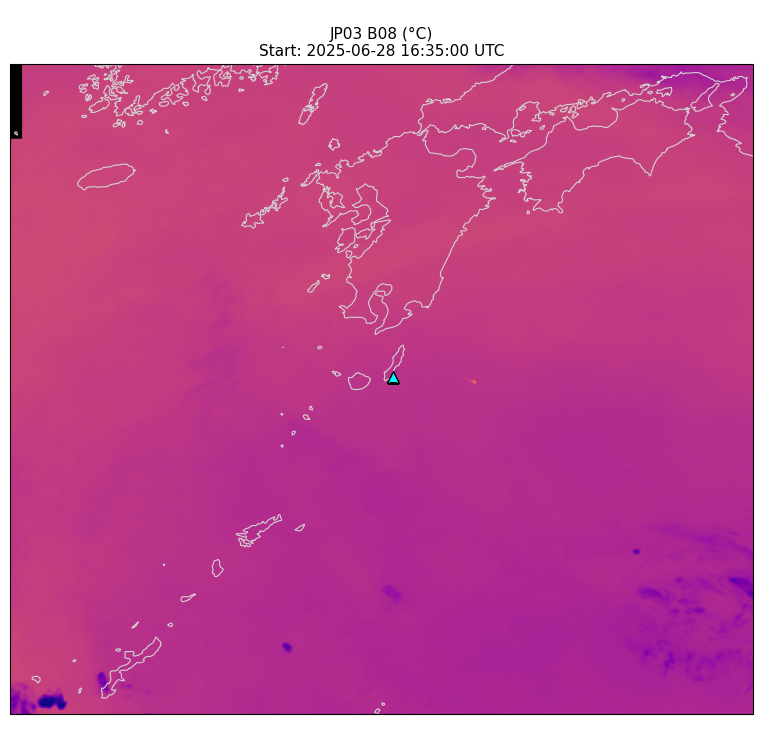
Japan’s GOSAT-GW Launch from June 28th 2025, 16:33 UTC
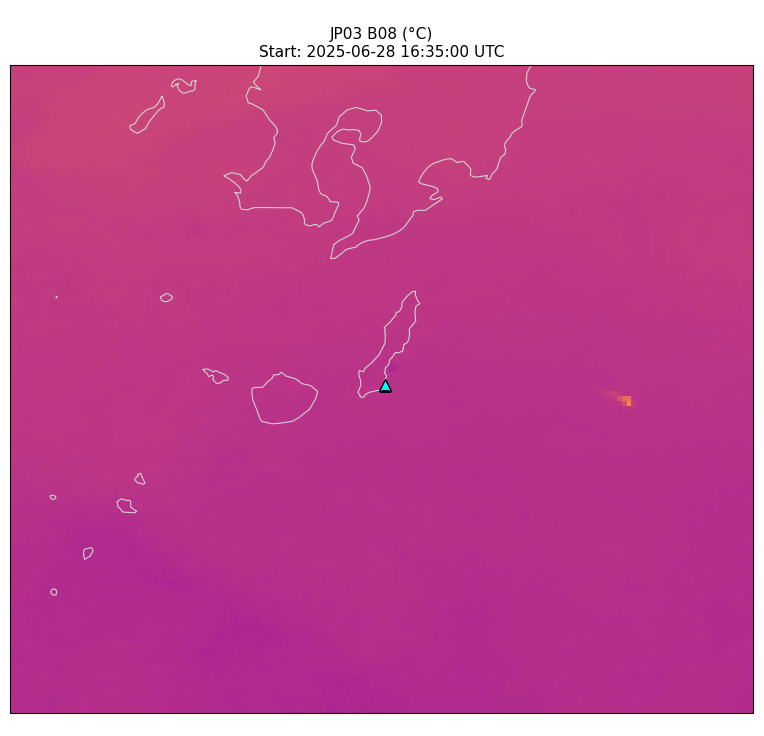
GOSAT-GW Launch detection in Himawari AHI Channel B08
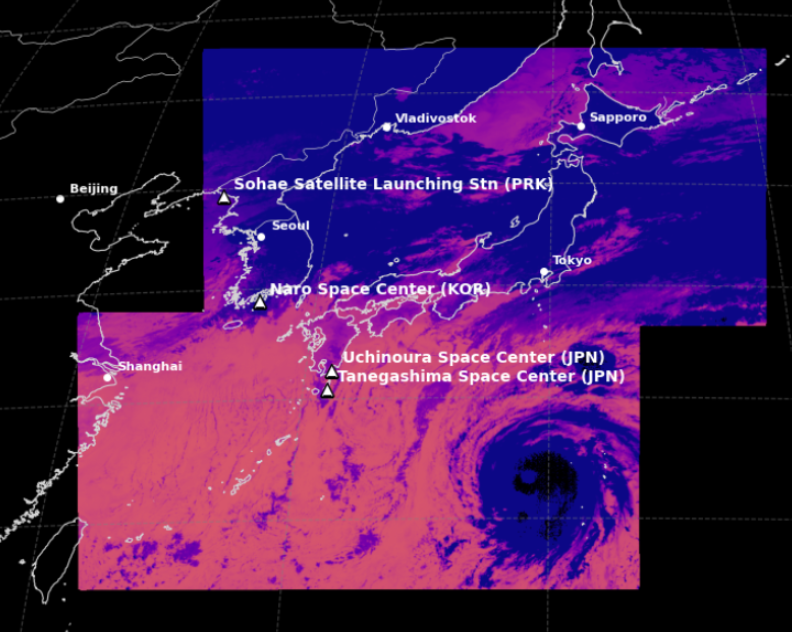
Himawari geostationary weather satellite mesoscale scan area
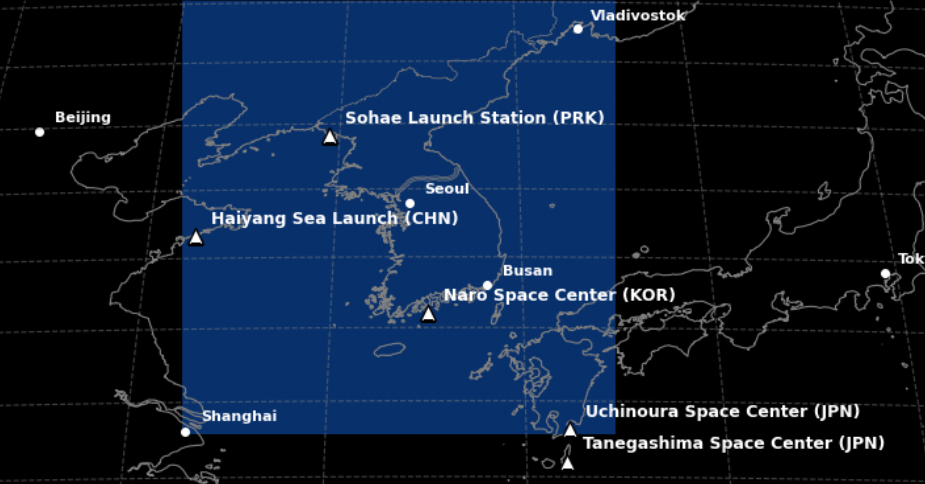
GK2A geostationary weather satellite mesoscale scan area
OWLAT Overview: NRO Publication Abstract
The United States Space Force and Intelligence Community maintain many exquisite early missile warning systems; however, these systems and their alerts exist at a restricted level. An application using open data from weather satellites to detect space launches for the SDA Tools Applications and Processing (TAP) Lab in Colorado Springs has been developed by the University of Colorado Boulder. This capability is based on previous results from meteorological research that demonstrate the ability for weather satellites such as the NOAA Geostationary Operational Environmental Satellites (GOES) to observe space launches. This unrestricted launch observation capability was transitioned into a novel unrestricted launch detection microservice that provides open launch alerts to the SDA TAP Lab. These alerts permit the rest of the SDA TAP Lab members to cue onto detected launches, maintain custody, and analyze the possible threat in a way not previously accessible in unclassified developmental environment.